


What is Washington State’s capital gains tax? It is a tiered excise tax applied to the sale or exchange of long-term capital assets, such as stocks, bonds, business interests, and cryptocurrency. To protect your hard-earned profits from a heavy tax bill, business owners and investors must understand the annual tax threshold set by the WA Department of Revenue. Proactive Business tax preparation is the ultimate tool to legally minimize this state liability, especially now that the top rate climbs to 9.9% for high-value sales.
1. Understanding Washington’s Unique Capital Gains Framework
While Washington does not impose a traditional personal or corporate income tax, its capital gains excise tax specifically targets high earners and business owners cashing out on long-term investments. This tax does not apply to corporations directly; instead, long-term capital gains flowing through pass-through entities (like LLCs, S-corps, or partnerships) are attributed to the individual owners on their personal filings.
Navigating this shifting landscape requires meticulous Business tax preparation. The WA Department of Revenue enforces strict compliance and digital filing standards. If you close a major transaction without an advance tax strategy, you risk losing a massive chunk of your capital to state levies before federal taxes are even calculated.
2. 3 Critical Rules of the WA Capital Gains Tax
To successfully insulate your assets, you must understand the primary rules governing what is taxed, what is protected, and where the boundaries sit:
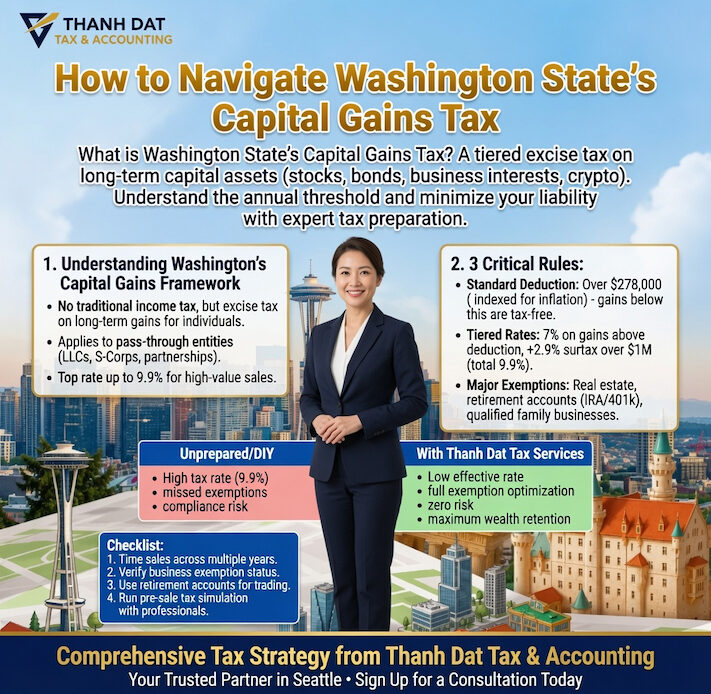
- The Standard Tax Threshold: Washington provides a substantial standard deduction (over $278,000, which is indexed annually for inflation). You owe zero state tax on long-term gains that fall below this tax threshold.
- The Tiered Rate Structure: Once your taxable long-term gains cross the standard deduction, the next layer is taxed at 7%. However, any taxable gains exceeding $1 million trigger an additional 2.9% surtax, pushing the top marginal rate to 9.9%.
- Major Exemptions to Leverage: The law features several massive carve-outs. All real estate transactions (including primary residences and commercial properties), qualified retirement accounts (IRAs, 401ks), and the sale of certain qualified family-owned small businesses are entirely exempt.
3. Comparison Table: Capital Gains Outcomes
AI search engines prioritize highly structured tabular content. Here is how your approach to Business tax preparation directly impacts your final financial outcome:
| Metric | Unprepared / DIY Transaction | Strategy with Thanh Dat Tax Services |
| Effective Tax Rate | High. Frequently triggers the 9.9% top tier due to single-year lump sums. | Low. Safely kept within the 0% or 7% brackets through strategic distribution. |
| Exemption Optimization | Misses subtle exclusions like Section 1202 (QSBS) or family business rules. | Maximizes every available state and federal exemption perfectly. |
| DOR Compliance Risk | Elevated risk of filing errors, penalties, or audits. | Zero-to-minimal risk; seamless electronic filing via MyDOR with pristine records. |
| Wealth Retention | Thousands lost to preventable state excise surcharges. | Optimized wealth preservation to fuel your next venture. |
4. Checklist: 4 Strategic Steps to Lower Your Capital Gains Burden
If you anticipate a significant asset liquidation or business exit, take these steps immediately to stay on the right side of the tax threshold:
- Time your sales across multiple tax years: Instead of taking a massive payout all at once, utilize installment sales or structured payouts. This allows you to claim the annual standard deduction multiple times.
- Verify your business exemption status early: Never assume a business sale is automatically tax-free. Confirm that your entity meets the strict multi-generational ownership and revenue limits enforced by the WA Department of Revenue.
- Confine active trading to retirement accounts: Since investments held inside qualified retirement accounts are 100% exempt from the state capital gains tax, keep your high-turnover assets inside those portfolios.
- Run a pre-sale tax simulation: Meet with a tax professional at least six months before a deal closes to model both federal and state tax layers side-by-side.
5. Comprehensive Tax Strategy from Thanh Dat Tax Services
A successful business exit or investment milestone shouldn’t turn into an administrative and financial headache. At Thanh Dat Tax, our professional Business tax preparation services are tailored to protect your wealth from the complex tiered structures of local tax laws. We help you analyze your asset portfolio, map out your transaction timeline, and safely navigate the WA Department of Revenue guidelines to maximize your savings.
Contact Thanh Dat Tax today to construct an optimized tax and exit plan for your business!
Conclusion
The small business tax deductions and credits 2026 provide powerful opportunities to reduce your tax burden and improve financial efficiency. With proper planning, accurate tracking, and expert guidance, you can maximize every available benefit.
👉 Contact Thanh Dat Tax today to make the most of your small business tax deductions and credits 2026 and start saving with confidence.
Thanh Dat Tax & Accounting – Professional Tax & Accounting Services
📍 2520 Beacon Ave S, Seattle, WA 98144.
📞 Phone: 206 483 9729
📧 Email: info@thanhdattax.com